The one-slide pitch
The idea
People already leave notes all over the house. This one talks.
Post-its go on the fridge, the bathroom mirror, the front door, the lunchbox. They work because they're cheap, they stick, and they're right where you'll see them. Audible Memories keeps all three and adds the one thing paper can't hold: a voice.
Instead of a photo, you capture a ten-second sound. A kid's laugh, a grandparent saying your name, a friend from the playa, or a reminder that's hard to ignore when it's said out loud.
Where it came from
It started with a pig grunt.
A pig grunt, recorded on one of these little boards. Press the button, hear the pig, press it again. That's the whole product test: if people can't stop pressing it, it works.
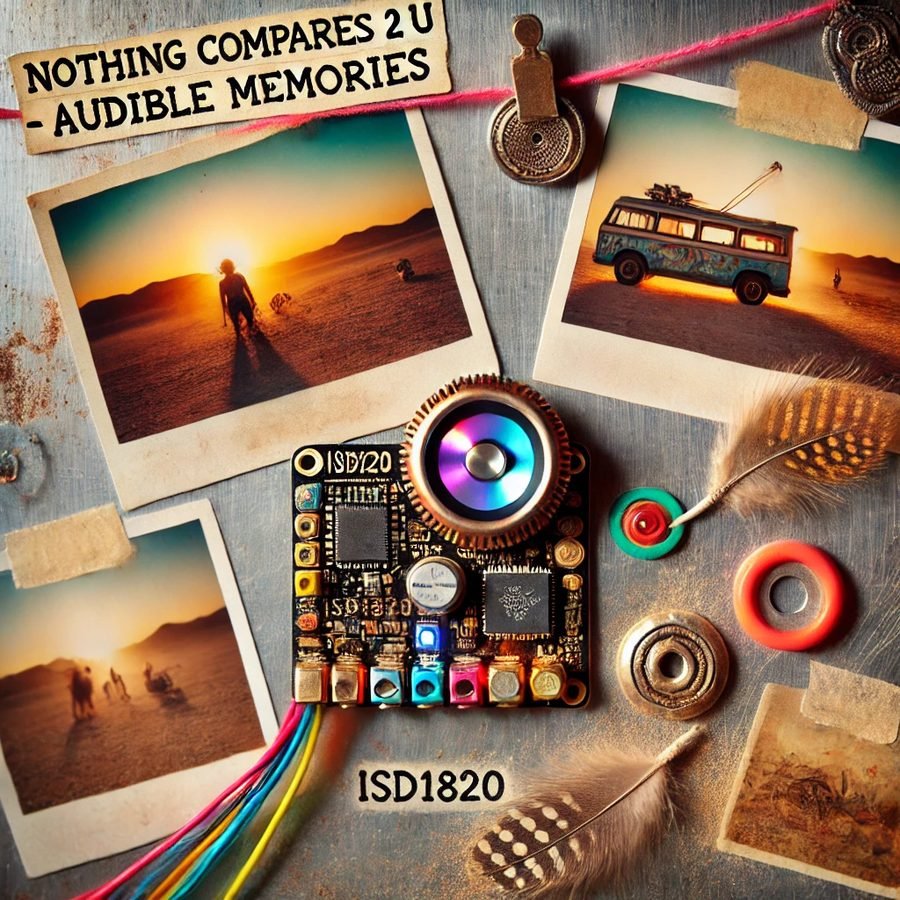
It grew into a Burning Man gift: a decorated, magnetic, touchable sound you hand to a friend. Read the original write-up on Kenny's blog: “Nothing Compares 2U” ISD1820 player, and more at kwm59.io/blog.
Try it
This is the whole user manual.
Hold REC and talk; it stops at ten seconds, like the real chip. Press PLAY to hear it back. Your recording stays in this browser tab and is never uploaded.
Who buys it
One cheap part, a lot of reasons to give it.
Souvenirs
Festivals, camps, weddings, reunions. Record it on site, take the moment home. Burning Man is the first test.
Reminders
“Trash night.” “Feed the hog.” “Lock the back door.” Harder to ignore than a yellow square.
Love notes
Kids' voices for a deployed parent, a grandparent's “goodnight,” a partner's good-morning.
Brand promos
Plumbers and pizza shops already pay for fridge magnets. This one says the phone number out loud.
DIY kits
Solder-it-yourself kit for makerspaces, scouts and STEM classes. A first electronics project that ends in a gift.
Workshops
Paid build parties: decorate, wire and record in an hour. Venues keep a cut.
Art pieces
Feathers, glitter, laser-cut silhouettes, bottle-cap shells. Each one a one-off.
Memorials
Ten seconds of a voice you don't want to forget, somewhere you'll pass it every day.
The numbers
Built for a low price and a high markup.
| Part | Role |
|---|---|
| ISD1820 voice module | Records and plays ~10 s, mic onboard |
| 8Ω 0.5 W mini speaker | Playback |
| CR2032 coin cell + holder | Power (small 3.7 V Li-ion if needed) |
| 2 mini push buttons | Record · play |
| Magnet backing | Sticks to the fridge |
| Printed or laser-cut shell | PLA, acrylic or bottle caps |
Estimated total for 500 units: $1,850 to $2,850, from the original parts list. Kits sometimes cover several lines.
| Pilot: 500 units | Low | High |
|---|---|---|
| Parts cost per unit | $3.70 | $5.70 |
| Target retail (finished magnet) | $15 | $20 |
| Gross margin per unit, before shipping and fees | ~75% | ~71% |
| Pilot revenue at a $15 average | $7,500 | |
| Pilot parts spend | $1,850 | $2,850 |
Target prices are planning assumptions, not sales data. Margin rows use the low cost against the $15 price and the high cost against the $20 price. Labor is excluded: the plan is community build nights.
Isn't this already a thing?
Partly, and that's good news.
Recordable magnets have been sold for years: multi-button family message boards, “talking heart” recorders, and newer custom photo-and-song fridge magnets. That proves people buy them. What those products aren't is cheap to make yourself, built at the event, or art you'd want to keep.
How we keep it ours
The ISD1820 is a commodity chip, so the circuit can't be locked up. The value is in everything around it:
- The name and the storyAudible Memories and the pig grunt are ours. Next step: check and file the trademark.
- Being first at the eventsFestival and camp relationships are hard to copy and easy to lose. We show up first.
- Community buildersA network of people who decorate and assemble, tied to the 5PM Cooperative.
- Design libraryShells, tags and kits with a look people recognize from across the room.
Maybe next · design pending
Perhaps pair it with OpenLE-Cast, Kenny's open-source project for broadcasting one phone's audio to many Auracast earbuds and hearing aids. A magnet that catches ten seconds of a silent-disco set, or one that broadcasts its clip to the whole room? Or museums: stand in front of a piece with your earbuds in, and they tune to that piece's own Bluetooth channel to play its story, no audio-guide rental needed. Tap a card, wristband or phone on an RFID/NFC reader by the piece and it switches you to that channel, or knows who you are and picks your language. Or keep the recording at the heart of it: the ISD1820 itself sits on the wall beside the piece, gets a Bluetooth transmitter, and a swipe of your RFID card starts its clip playing in your earbuds. Who knows. Not thought out yet. Design pending.
How it's built
Six parts, four connections.
- Battery to VCC and GND on the ISD1820.
- Speaker to SP+ and SP−.
- Record button between REC and GND.
- Play button between PLAYE and GND. On edge trigger, playback runs through the clip after one press; PLAYL plays only while held.
- Glue to a magnet, close it in a shell, decorate.
Wiring
CR2032 (−) → GND
Speaker → SP+ / SP−
Button A → REC ↔ GND
Button B → PLAYE ↔ GND
Magnet → back of shell
Full parts links and schematic: kwm59.io/isd1820player.
The ask
$2K builds the first 500.
Crypto preferred. Wallet address: see page 20.
One angel can fund the pilot run, and community build nights keep labor near zero. Next comes a festival launch, an online shop and kits for makerspaces. Partners with event access, retail, or packaging and promo-product experience are welcome too.
Wallet address (page 20) Talk to Kenny on LinkedIn Read the origin post